

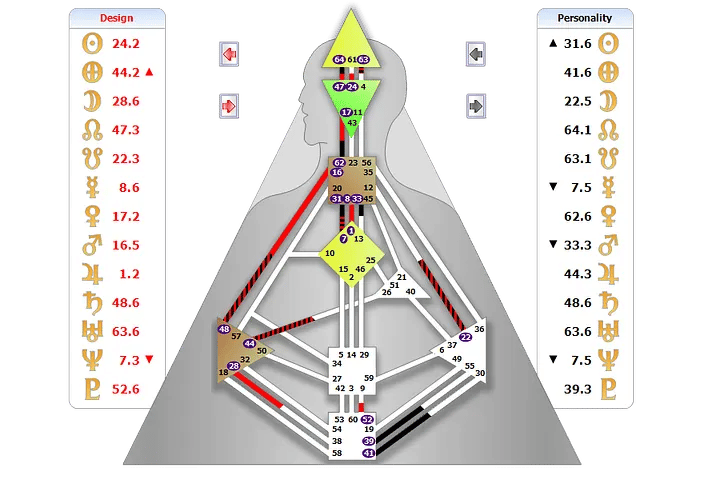
When we look at a Human Design BodyGraph, usually it’s accompanied by four arrows at the top of the chart or on the side of it.
These “transformations,” also referred to as “variables,” represent how we relate to the physical world in terms of digestion, environment, perspective, and awareness. Human Design teaches us to make decisions from the body rather than the mind. So if we’re in environments where we feel overlooked or have poor eating habits, an approach to life that leaves us feeling disempowered, or we’re absorbing information in a way that leaves us with more chaos than clarity, we won’t feel as aligned in our life as we could be.
As kids, we allowed our instincts to lead us.
As adults, we allow logic to guide us at the cost of intuition. We’ve all experienced those moments where our gut told us something was off and maybe we didn’t listen and the outcome was unfavorable. Or those moments where we did listen to our gut and avoided a complete disaster.
By taking stock of our Human Design variables, we learn the best approach to operate from and the best places to operate in, as well as how.
People with all left-facing arrows tend to be systematic and less intuitive with their approaches. For example, these are the people who eat according to a schedule. They prefer to live according to a routine, something predictable. Whereas, people with right-facing arrows are a bit more intuitive and spontaneous. They eat when they’re hungry and drink when they’re thirsty.
People with a left-facing arrow where ‘environment’ is (bottom left) prefer familiar places.
These are the people who have a favorite dive bar or café they like to frequent. Think of those characters you see in TV shows who always seem to be in the same seat, ordering the same thing, and is known by all of the cast members on a first name basis. Consistency is key for them.
On the other hand, people with a right arrow facing environment need less routine.
This doesn’t mean they can’t do well with a schedule, but they’re more likely to try new places and switch up their day to day activities. They require a little more stimulation than the left arrow folks. They’re here to gain new experiences and feel relaxed in them.
Now if we take a look at our Human Design perspective on the bottom right hand side, that’s going to play a role in how we go about manifesting our desires and accomplishing our goals.
Left arrow facing folks are advised to get as detailed as they possibly can about what they want, where at, what color, how it feels — things of that nature. Right arrow folks don’t have to go through all of that, though. They can simply use their imagination to gather a general idea what they want and they will attract it if they don’t doubt themselves and take whatever practical step is necessary.
For the top right arrow in a chart, it speaks to our awareness.
It’s how we absorb and perceive information. Of course, our left-facing arrow people will prioritize details. Our right-facing arrow people may focus on the bigger picture. Neither individual is wrong, it’s simply how they process things.
So if you’re someone with mixed arrows in general, you prefer to do certain things with more specificity and other things with more intuitiveness.
If you want to learn more about the four variables in Human Design, otherwise known as ‘transformations,’ grab your copy of “Projector Insights: How to Live Your Human Design.”
It has everything you need to know about being a Human Design Projector and includes practical examples, tips, and references.
Until next time.
-Fe